Agricultural & Cold Storage Insulation Yakima, WA
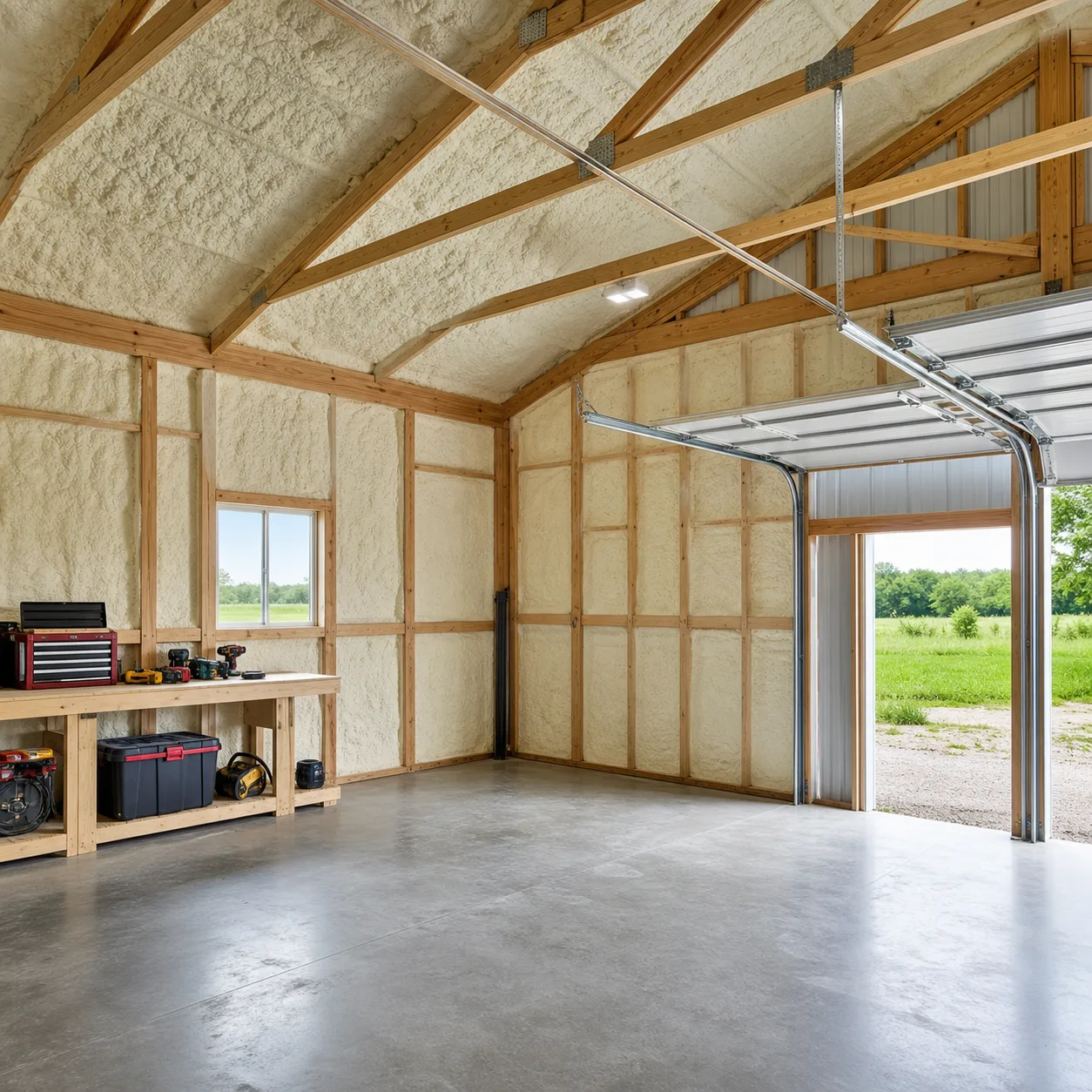
Yakima Spray Foam Pros installs spray foam insulation for agricultural buildings, cold storage, and packing facilities across Yakima County.
Agriculture is one of the largest drivers of building insulation demand in the Yakima Valley. Orchard cold storage rooms, fruit packing and sorting sheds, wineries, hop-drying buildings, and equipment barns all depend on a building envelope that can hold a stable interior condition, resist condensation, and stand up to daily use by trucks, forklifts, and crews. Spray foam is a common choice for these buildings because it insulates and air seals in a single application, which matters more in a working agricultural building than in a typical office or home.
Why Agricultural Buildings Need a Different Approach
A house and a packing shed are not insulated the same way. Agricultural buildings are often larger, taller, and built with metal panel or post-frame construction, with big door openings, forklift traffic, and equipment that generates its own heat or cold. Many also run mechanical cooling or controlled-atmosphere storage for fruit, which raises the stakes on air sealing: every gap in the envelope is a path for conditioned air to escape and outside heat or moisture to get in. We review the building's actual use, not just its square footage, before recommending a foam type and depth.
Common Agricultural and Cold Storage Projects
- Orchard cold storage and controlled-atmosphere storage rooms.
- Fruit packing, sorting, and processing buildings.
- Wineries, tasting rooms, and hop-drying or storage buildings.
- Equipment barns, implement storage, and farm shops.
- General agricultural warehouses and loading areas.
Condensation and Temperature Stability
Condensation is usually the top concern in Yakima's agricultural buildings. Warm, moist air meeting a cold metal roof or wall creates moisture that can drip onto stored fruit, packaging, equipment, or concrete floors, and Yakima's temperature swings between hot summer days and cold winter nights make this a year-round issue rather than a seasonal one. A continuous spray foam layer reduces the air movement against the metal skin that causes condensation, and it slows heat transfer so mechanical cooling or heating systems are not fighting a leaky envelope. This is the same principle behind our metal building condensation guide, applied at agricultural scale.
Planning an Agricultural Insulation Project
Agricultural buildings usually need more logistics planning than a residential job. We look at harvest season timing, product or equipment that needs to be moved or protected, refrigeration and mechanical systems already in place, forklift and truck access, purlin and girt spacing on post-frame buildings, and whether the building needs to stay partially operational during the work. Overspray protection is critical around stored product, packaging materials, and food-contact surfaces. A clear scope and schedule matter as much as the foam itself on a working farm or packing operation.
Washington State Energy Code and Agricultural Buildings
Commercial and agricultural construction in Yakima County can fall under the commercial provisions of the Washington State Energy Code (WSEC), depending on the building's use and occupancy classification. Some agricultural structures are treated differently than conditioned commercial space under the code, so classification matters before assuming a specific insulation requirement applies. We recommend confirming how a specific building is classified, and what insulation and air-sealing provisions apply, with the Yakima County building department before finalizing project plans.
Spray Foam vs Traditional Insulation for Ag Buildings
Batt insulation and rigid board are common in agricultural construction because they are inexpensive, but they depend on careful, continuous installation to perform, and large open bays, purlins, and irregular framing make that hard to achieve consistently. Batts can also sag or separate from metal panels over time, leaving gaps that undo the insulation value in exactly the areas most exposed to condensation. Because spray foam adheres directly to the panel and expands to fill irregular gaps, it holds its air-sealing performance in the kind of large, mechanically fastened metal buildings that are common on Yakima Valley farms and packing operations, without relying on a perfect, gap-free fit from a rigid material.
Frequently asked questions
Do you insulate orchard cold storage and controlled-atmosphere rooms?
Yes. Cold storage and controlled-atmosphere buildings are a regular part of our agricultural work in Yakima County, where stable temperature and condensation control are the main priorities.
What foam type is typically used in agricultural cold storage?
Closed-cell foam is commonly used in cold storage and refrigerated buildings because of its density, moisture resistance, and higher R-value per inch in limited depth, though the right choice depends on the specific building and assembly.
Can you work around harvest season or an active packing operation?
Scheduling is discussed as part of project planning. Many agricultural jobs need to work around harvest timing, product storage, or partial building use, so this should be reviewed before a project date is set.
Is a packing shed or cold storage building insulated differently than a house?
Yes. Scale, mechanical systems, product protection, and access equipment all change how the job is planned and staged compared to a residential attic or crawl space.
Does spray foam help control humidity in a packing or storage building?
Spray foam air seals the building envelope, which reduces the outside air and moisture that can enter through gaps. It works alongside, not instead of, any mechanical humidity or refrigeration controls the building already has.
Do agricultural buildings need to meet Washington State Energy Code requirements?
Some do, depending on occupancy classification and use. Confirm how a specific building is classified and what requirements apply with the Yakima County building department before budgeting a project.